
THE PROBLEM
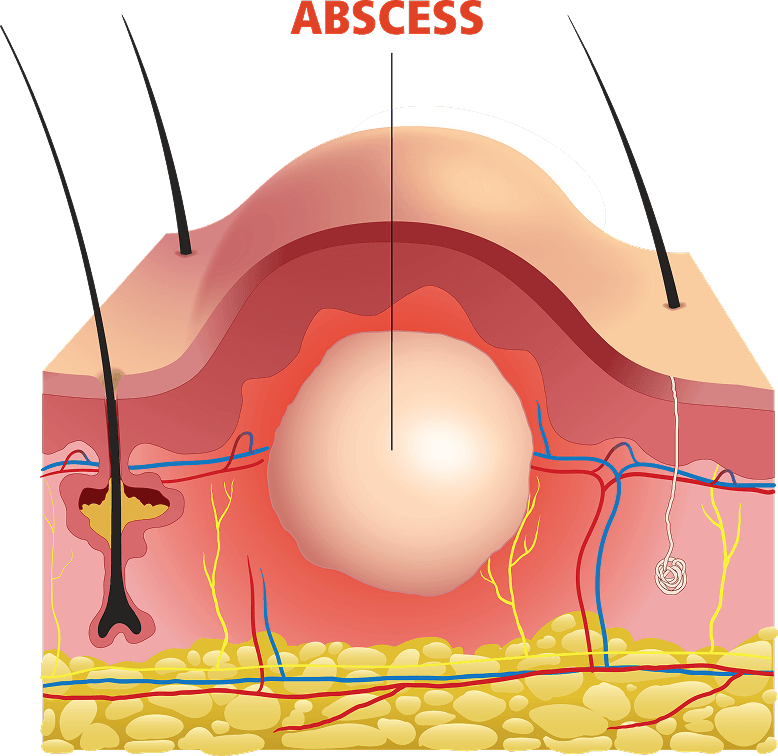
Skin abscess treatment is outdated and inconvenient for patients
Skin Abscess treatment practices have remained relatively unchanged for the past 50 years, with no universally adopted guidelines for the management of subcutaneous abscesses[5-8].
Due to the non-urgent nature of the procedure, inpatient stays of 2–3 days are common, with many cases delayed or ‘bumped’ from theatre schedules[10, 11]. Data indicate that fewer than 20% of patients are admitted and discharged on the same day[12]. As a result, patients often experience prolonged hospital stays and undergo multiple fasting periods while awaiting surgery[11, 12]. These delays and repeated cancellations have been associated with lower patient satisfaction and poorer overall experience [13, 14], with extended fasting perceived as a sign of disorganisation and inadequate communication from healthcare providers[13, 15].
Inaccessible treatment for rural and remote communities
Hospitalisation rates for skin infections in Western Australia are significantly higher in rural and remote communities, particularly among Aboriginal children —15 times higher than for non-Aboriginal children, with abscesses accounting for 42% of cases [8,9]. These rates increase with remoteness, and repeat admissions are more common, reflecting ongoing challenges in access to care [9].
In many remote areas, patients are unable to receive treatment within their community and must travel to regional centres for a procedure that is otherwise straightforward. This creates delays in receiving timely care and can deter individuals from seeking treatment altogether, leading to worse health outcomes and placing further strain on already stretched healthcare resources.


High economic burden and a strain on critical resources
Currently, in-theatre skin abscess treatment costs WA an estimated AU$5 million annually, rising to over AU$50 million nationally, with most of the cost borne by the public healthcare system. By shifting treatment from a high-cost theatre setting to lower-cost clinics, there are potential savings of over 60% on the current treatment costs. This approach not only eases the economic burden but also frees up critical resources such as theatre time, bed-days, and staff which are already under significant strain across WA Health and globally.
The addressable market for abscess treatment is significant. In Australia, hospital admissions for skin abscesses increased by 48% between 1999 and 2008 [10], with an annual hospitalisation rate approximating 62 per 100,000 population [10] and a median cost per admission of $4,314.40 (2023) [16]. Internationally, the demand is greater, with 3.28 million people affected by skin abscesses in the U.S. in 2005 alone [14,15]. These figures are expected to rise with population growth and increasing obesity rates.
References
- White Rose Surgical Collaborative and MAGIC Collaborators , Management of subcutaneous abscesses: prospective cross-sectional study (MAGIC), British Journal of Surgery, Volume 111, Issue 8, August 2024, znae162, https://doi.org/10.1093/bjs/znae162
- Schmitz, G., Goodwin, T., Singer, A., Kessler, C., Bruner, D., Larrabee, H., May, L., Luber, S., Williams, J. and Bhat, R. (2013). The Treatment of Cutaneous Abscesses: Comparison of Emergency Medicine Providers’ Practice Patterns. Western Journal of Emergency Medicine, [online] 14(1), pp.23–28. doi:https://doi.org/10.5811/westjem.2011.9.6856.
- Thomas, O., Ramsay, A., Yiasemidou, M., Hardie, C., Ashmore, D., Macklin, C., Bandyopadhyay, D., Bijendra Patel, Burke, J.R. and Jayne, D. (2020). The surgical management of cutaneous abscesses: A UK cross-sectional survey. Annals of Medicine and Surgery, [online] 60, pp.654–659. doi:https://doi.org/10.1016/j.amsu.2020.11.068.
- Yang, P.F., Builth‐Snoad, L., Ng, K., Gu, E., Errington, B., McBride, K.E. and Lee, P.J. (2024). Optimizing theatre utilization for abscess drainage: going beyond priority categories. ANZ Journal of Surgery, 94(4), pp.648–654. doi:https://doi.org/10.1111/ans.18919.
- Baker J, Windsor J. Management of adult superficial acute abscesses in a tertiary hospital: time for incisive action. N Z Med J. 2009 May 22;122(1295):37-46. PMID: 19648985.
- Ulrych, J. (2023). Cutaneous and Subcutaneous Abscesses. Springer eBooks, pp.1725–1736. doi:https://doi.org/10.1007/978-3-031-22599-4_114.
- Rühle, A., Oehme, F., Metzger, J., Babst, R., Link, B.-C. and Beeres, F.J.P. (2019). International survey evaluating treatment of primary superficial skin abscesses. European Journal of Trauma and Emergency Surgery, 47(4), pp.1049–1056. doi:https://doi.org/10.1007/s00068-019-01279-y.
- Davidson, L., Knight, J. and Bowen, A.C. (2019b). Skin infections in Australian Aboriginal children: a narrative review. The Medical Journal of Australia, [online] 212(5), pp.231–237. doi:https://doi.org/10.5694/mja2.50361.
- Abdalla, T., Hendrickx, D., Fathima, P., Walker, R., Blyth, C.C., Carapetis, J.R., Bowen, A.C. and Moore, H.C. (2017). Hospital admissions for skin infections among Western Australian children and adolescents from 1996 to 2012. PLoS ONE, [online] 12(11). doi:https://doi.org/10.1371/journal.pone.0188803.
- Vaska, V.L., Nimmo, G.R., Jones, M., Grimwood, K. and Paterson, D.L. (2011). Increases in Australian cutaneous abscess hospitalisations: 1999–2008. European Journal of Clinical Microbiology & Infectious Diseases, 31(1), pp.93–96. doi:https://doi.org/10.1007/s10096-011-1281-3.
- El Boghdady, M., Ewalds-Kvist, B.M., Zhao, S., Najdawi, A. and Laliotis, A. (2022). Post-operative antibiotics for cutaneous abscess after incision and drainage: Variations in clinical practice. Access Microbiology, 4(10). doi:https://doi.org/10.1099/acmi.0.000441.
- Chong V, Zhou L, Hundal H, Koea J. Acute surgical treatment of cutaneous abscesses: cost savings from prioritisation in theatre. N Z Med J. 2014 Aug 1;127(1399):51-7. PMID: 25145306.
- Baker J, Windsor J. Management of adult superficial acute abscesses in a tertiary hospital: time for incisive action. N Z Med J. 2009 May 22;122(1295):37-46. PMID: 19648985.
- Blenkinsop L, Ramsingh J. Management of Acute Abscesses by Day-Case Surgery: A Retrospective Analysis and Feasibility Study. Cureus. 2024 Dec 11;16(12):e75568. doi: 10.7759/cureus.75568. PMID: 39669648; PMCID: PMC11635128.
- Taira, B.R., Singer, A.J., Thode, H.C. and Lee, C.C. (2009). National epidemiology of cutaneous abscesses: 1996 to 2005. The American Journal of Emergency Medicine, 27(3), pp.289–292. doi:https://doi.org/10.1016/j.ajem.2008.02.027.
- Li, C., Nguyen, P., Garg, P., Pham, H., Hitos, K. and Pang, T. (2023). Improving Quality Metrics with a Day-only Skin Abscess Protocol: Experience from Australia. World Journal of Surgery, 47(6), pp.1486–1492. doi:https://doi.org/10.1007/s00268-023-06941-6.
- Ashton F, Hamid K, Sulieman S et al (2017) Factors influencing patient experience and satisfaction following surgical management of ankle fractures. Injury 48(4):960–965
- Carey SK, Conchin S, Bloomfield-Stone S (2015) A qualitative study into the impact of fasting within a large tertiary hospital in Australia–the patients’ perspective. J Clin Nurs 24(13–14):1946–1954